THE HARMONY PLATFORM

From data to the next generation of care for hematological malignancies

The HARMONY Platform

The HARMONY Platform is a secure, high-quality research ecosystem designed to accelerate data-driven innovation in haematology. It brings together over 120,000 anonymised patient records from across Europe — including clinical, genomic, molecular, and omics data from hospitals, study groups, registries, and clinical trials. 

Unlike federated systems, the HARMONY Platform enables true data pooling in one centralised environment. All data are fully anonymised, harmonised and standardised using the OMOP Common Data Model, and curated to the highest scientific and technical standards. 

For more than 8 years, the platform has powered high-impact research by providing structured, secure access to real-world data — supporting collaboration, insight generation, and better outcomes. 

What the HARMONY Platform offers

Data Scale
and Diversity

The largest data lake in Europe on haematological malignancies, sourced from multiple countries and different types of organisations.

Security
and Privacy

Built with strong data governance and compliance with GDPR, the HARMONY Platform allows secure analysis of anonymised data within a centralised infrastructure.

Data Quality
and Harmonization

Our rigorous data curation and harmonisation to OMOP CDM ensure high-quality, standardised data that supports reliable, reproducible research. 

Advanced
Analytics

Harmonised data allows for the implementation of state-of-the-art analytical tools, AI/ML capabilities, and robust, high-powered analysis. 

Interoperability

The HARMONY Platform ensures interoperability through OMOP CDM, ontologies, and FAIR data principles.

Support Tools

We know that OMOP is not the most user-friendly format. That’s why we have developed a suite of tools that enhance the visualisation, exploration, and analysis of data on the platform — making it easier to understand and interpret the information it contains.

Data Scale
and Diversity

icon

Data Scale
and Diversity

The largest data lake in Europe on haematological malignancies, sourced from multiple countries and different types of organisations.

Security
and Privacy

Security
and Privacy

Built with strong data governance and compliance with GDPR, the HARMONY Platform allows secure analysis of anonymised data within a centralised infrastructure.

Data Quality
and Harmonization

icon

Data Quality
and Harmonization

Our rigorous data curation and harmonisation to OMOP CDM ensure high-quality, standardised data that supports reliable, reproducible research. 

Advanced
Analytics

Advanced
Analytics

Harmonised data allows for the implementation of state-of-the-art analytical tools, AI/ML capabilities, and robust, high-powered analysis. 

Interoperability

icon

Interoperability

The HARMONY Platform ensures interoperability through OMOP CDM, ontologies, and FAIR data principles.

Support Tools

Support Tools

We know that OMOP is not the most user-friendly format. That’s why we have developed a suite of tools that enhance the visualisation, exploration, and analysis of data on the platform — making it easier to understand and interpret the information it contains.

The Data

From Silos to Actionable Insight

The HARMONY Platform transforms isolated, multi-source data into high-quality, research-ready datasets through a structured and secure process. Unlike federated approaches, HARMONY enables true data pooling by storing standardised, anonymised records in its data lake.

Data becomes accessible within a governed infrastructure designed to protect patients  while enabling seamless collaboration. 

Our data management process 

Tools

From Data to Decisions

The HARMONY Platform is more than a data repository.
It is a research environment built to translate data into insight. Our tools are designed to make anonymised, harmonised datasets accessible and useful for clinicians, researchers and decision-makers.

These web-based tools allow users to explore baseline data, test assumptions, and support the generation of research questions or treatment strategies. They demonstrate the potential of the HARMONY Platform to accelerate hypothesis testing and clinical understanding without requiring direct access to raw datasets.  

Data Exploration Tools

ALL and AML Data Visualization Tools

The HARMONY Data Exploration Tools are interactive dashboards designed to support hypothesis generation using anonymised, harmonised data from the HARMONY Big Data Platform.  

Users can select specific cohort characteristics and instantly see how many cases match those parameters. This helps researchers assess data availability on the Platform and refine their study design before submitting a formal proposal. 

Would you like to explore the data visualization tools for ALL and AML?

What can you do with them?  

These tools offer a transparent first look into the data and help ensure research questions are supported by a sufficient number of cases. More exploration tools are in development and will be added to this section soon. 

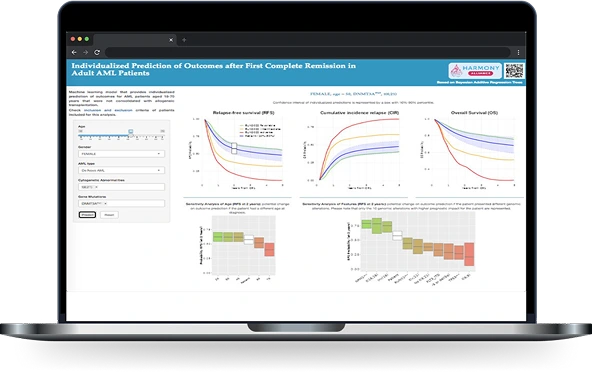
HARMONY AML Outcome Predictor Calculator

This tool provides an individualized prediction of outcomes for AML patients aged 18 to 70 who have achieved first complete remission (CR1) but were not consolidated with allogeneic transplantation.

It uses a machine learning model trained on real-world HARMONY data to support treatment decision-making, particularly in countries where targeted therapies are limited. Clinicians can use it to evaluate whether a patient may benefit from allogeneic transplantation. 

HARMONY MM Risk Stratifier 

The HARMONY MM Risk Stratifier is an online tool that supports risk classification for patients with newly diagnosed multiple myeloma. It uses harmonized, anonymized real-world data from the HARMONY Big Data Platform to estimate the probability of early progression or adverse outcomes based on individual patient characteristics. 

The model includes clinical and laboratory features such as age, disease stage, cytogenetics and initial treatment strategy. It accounts for patient variability and differences in treatment access across European centres, making it especially relevant for real-world settings where clinical trial data may not fully apply. 

This tool enables more refined risk stratification at diagnosis and may support treatment planning and study design in multiple myeloma. 

Spain

  • PETHEMA – Programa Español de Tratamientos en Hematología
  • Jose Carreras Leukemia Research Institute
  • Spanish CETLAM Cooperative Group
  • Hospital 12 de Octubre – i+12 Instituto de Investigación
  • Hospital Universitario La Fe
  • Fundació Institut Mar D´Investigacions Mèdiques
  • Complejo Asistencial Universitario de Burgos
  • Ramon y Cajal University Hospital
  • Infanta Leonor Hospital
  • Costa del Sol Hospital
  • Hospital General Universitario Valencia
  • Catalan Registry of CML
  • Hospital Universitario de Gran Canaria Doctor Negrín
  • GESMD – Grupo Español de Síndromes Mielodisplásicos
  • FICUS – Fundación de Investigación del Cáncer de la Universidad de Salamanca / CIC Salamanca
  • Registro Gammapatías Castilla y León