
In this news post, we share results from research projects conducted within the HARMONY Platform that have been published in 2025.
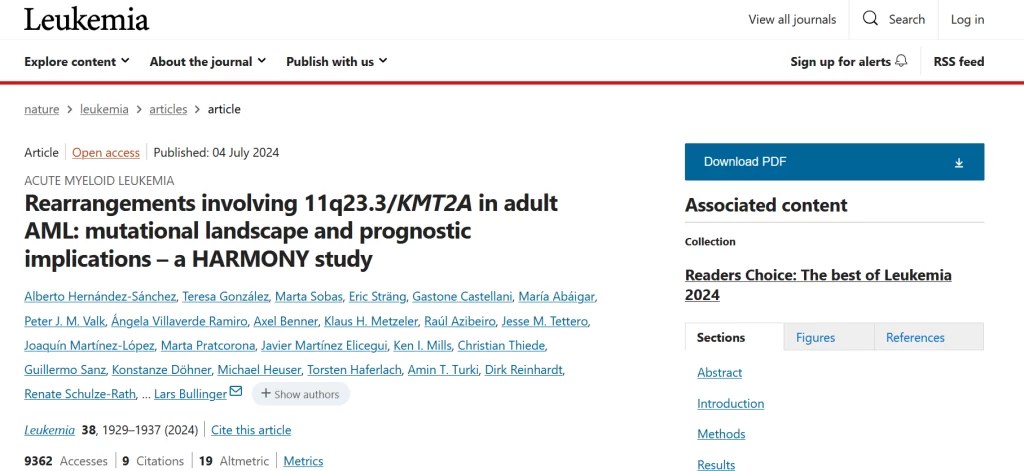
A screenshot of one of the papers talked about in the article.
The HARMONY Alliance Foundation continues demonstrating the added value of collaboration and data sharing by publishing the results of several research studies in hematology that have been conducted within the HARMONY Platform. In this news post, we are going through the most relevant results from the last 12 months: four different papers published in high-impact journals.
“Rearrangements involving 11q23.3/KMT2A in adult AML: mutational landscape and prognostic implications – a HARMONY study” was published on the 4th July 2024 in Nature. This piece of work studies how rearrangements in the KMT2A gene affect patients with acute myeloid leukemia (AML), as well as the potential correlation between these rearrangements and Overall Survivability. It was published as an open access paper in the Leukemia journal.
On January 9, 2025, the following paper was published in Blood (Ash Publications), titled “Acute promyelocytic leukemia: long-term outcomes from the HARMONY project”. It focuses on treatment outcomes for acute promyelocytic leukemia (APL) with all-trans retinoic acid (ATRA) and arsenic trioxide (ATO). Specifically, this study aimed to validate the data available regarding these treatments in a large patient cohort that has been collected within the HARMONY Platform.
In May of 2025, researchers from the HARMONY AML Group published “Outcomes with intensive treatment for acute myeloid leukemia: an analysis of two decades of data from the HARMONY Alliance”. In this study, a large pan-European multicenter dataset of the HARMONY Platform was used to evaluate outcomes for AML patients over two decades. The data retrieved from the HARMONY Platform included 5,359 AML patients with treatment-time dependent outcomes. Within the time frame covered by the study, the 5-year survival of AML patients improved significantly, also across different genetic risk groups. In particular, the 60-day mortality rate dropped from 13.0% to 4.7% over time. Results are available in Open Access in Haematologica.
Also in May, another article was released in the British Journal of Haematology (open access): “Comparability of external and internal control patients for the prospective randomized HOVON-103 trial in older AML patients”. This study assessed the comparability of external real-world cohorts from the HARMONY data platform with internal controls from the HOVON-103 clinical trial. Results showed strong alignment, highlighting the robustness of HARMONY data for supporting and validating clinical trial findings in older patients diagnosed with acute myeloid leukemia (AML).
We extend our sincere thanks and congratulations to all researchers involved in these publications. At the HARMONY Alliance Foundation, we remain committed to enabling data-driven research, fostering collaboration, and transforming patient care through innovation.